Saturday, November 30, 2024

Chitakash, Subtle body, Mind...

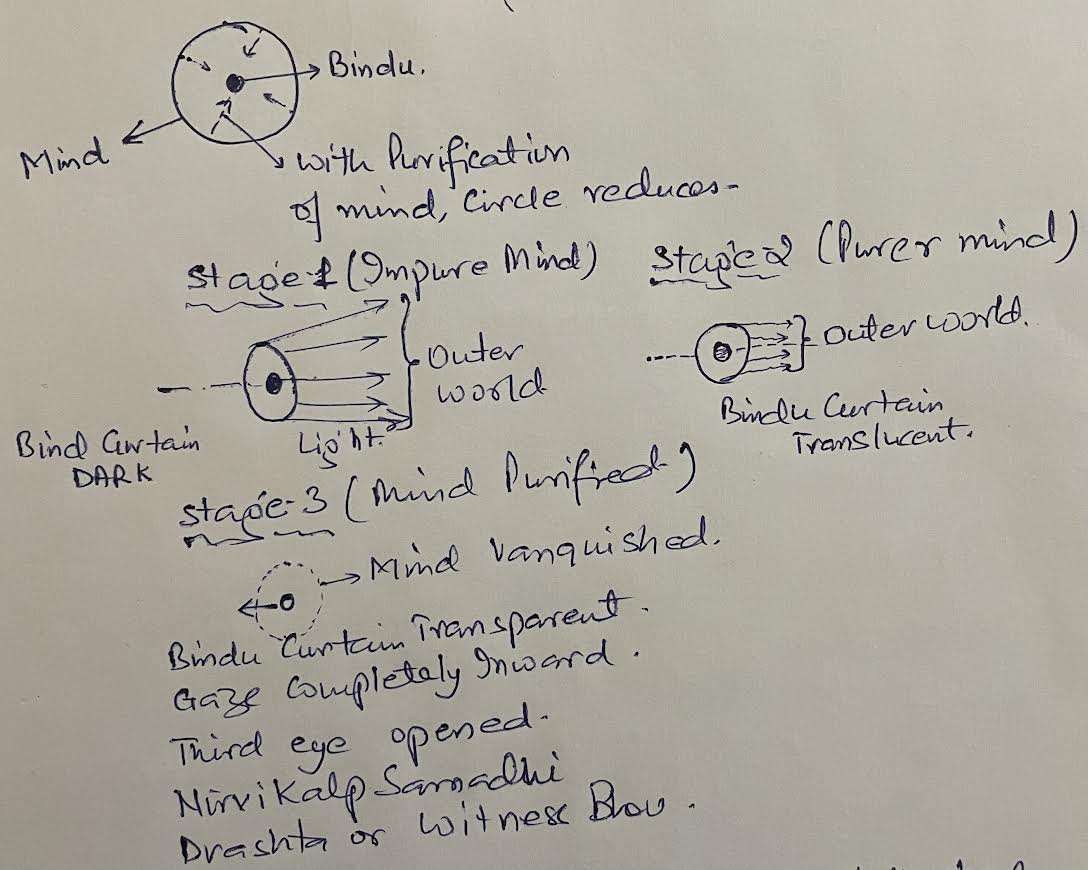
Between the two eyes , a little backwards is another Eye/ Chakshu/ चक्षु. It comprises of mind represented by circle and pran represented by a bindu in the centre. 


Purer the mind smaller the circle and impurer the mind bigger the circle. As we improve our mind this circle reduces and tends towards the central bindu. The radius of te circle represents te vrittis or maya which propell a jiva into the world. 


Bindu/ बिन्दु is the point where chitakash/ चित्ताकश opens and one sees 'scene' there. Chitakash is called subtle body. Thus inside the physical body, is the subtle body which lies inside the bindu of the third eye also represented by third eye. Light from the mind is being thrown outwards due to which we are able to see the world. As mind gets purified this gaze starts turning inwards. Then less and less of the outer world is seen. When mind becomes pure, it turns inward totally and circle merges into bindu and third eye opens.


When mind is totally ignorant at that point the bindu is covered with a dark curtain, when it gets a little purified than it becomes translucent and when it gets totally purified than it becomes transparent. Scene is seen in this space of Chitakash/ चिताकाश in the bindu/ बिन्दु and now the one who is seeing That scene is the 'Drashta/ Witness'. When this happens Sarv Vritti Nirodh/ सर्व वृत्ति निरोध () takes place ad one attain Nirvikalp Smadhi. 

When mind merges into Anatama, it is called Gross or Jad (जड) samadhi (समाधि),

When mind merges into both Anatm/ अनात्म and Atma/ अत्मा, it is called Savikalp Samadhi/ सविकल्प,

When mind merges into pure Atma/ आत्मा, it is called Nirvikalp Samadhi/ निर्विकल्प.

When Adho Drishti/ अधो दृष्टि (Downward or outer gaze) occurs Darshan (one sees) of Brhamand/ ब्रह्माण्ड (material world) takes place, it is through Karma (कर्म)/ action.

When Madhya/ मध्य Drishti/ दृष्टि or Sam/ सम takes place, then Kaivalya Darshan (कैवल्य दर्शन) takes place, it is through gyan or knowledge.

When Urdhav/ उर्धव (upward) gaze takes place then Bhagwat darshan (भगवत दर्शन) takes place, it takes place through Bhakti. 

Veils over different states are cut with initiation from the guru. First veil (आवरण) by Karma, Second by knowledge and third by Bhakti (भक्ति)/ Kripa (कृपा)/ Grace...Om!.....Shaktanand.

subject matter explained from writings in Svasamvedan, written by Pandit Gopinath Kaviraj.  

Kala, Kripa (Grace)

Kala:

 Kala/ कला from physical body comes out through speech as well as gaze. Through more kala comes out as compared to speech, thus just by seeing one can fathom a person. The person in which pure kala is working, he is initiated one, his Kundalini/ कुण्डलिनी has awakened. Now question is where do these kalas go after getting out from its source? Lower level jeevas are made out of it. So we can say on one side, kala is sent out and other side it is being received. The kala which is descending from the upper realm is being taken up by the lower realm. 

Kala which is coming out of the Mandal/ मण्डल gets collected by Golok;

Kala which is sent out by Golok/ गोलोक is being collected by Dhruvlok;

Kala which is issued by dhruv lok/ ध्रुवलोक is collected by Swarglok/ स्वर्गलोक (heaven);

Kala which is sent out by heaven, descends through two paths,

1. Descends through Devlok/ देवलोक (Divine realm) into the forehead, this happens in case of uninitiated person.

2. Descends through pure path and descends near initiated person. 

Jhatika kala (झटिका कला) which is descending from upper level jeevasis received by lower jeevas. 

All gross matter has grades, that is why kalas are. Who consumes kala? Its Agni or fire. All fires cannot eat all kalas. Kala which is above the forehead, that cannot be consumed by Agni because that is Amrit kala (अमृतकला). Agni (अग्नि)/ fire is Kaal or time. Agnikala descends from kaal in the form of Mrityu/ मृत्यु (death)-kala/ कला. This is impurity of bhav and birth etc. 

Shudh or Pure kala never leaves a person, only impure kala comes out. Pure kala (शुद्ध कला) is assimilated inside. It is never annihilated but a veil is put over it. 

Kripa (Grace):

One who is complete or poorn only they are free and beyond duality. While mukt or Siddh jeevas are still bound. Thus kripa or grace can be provided by only one who is complete. This grace is of two kinds, one is ordinary and other is special. The purpose of kripa (कृपा) or grace is brng the jeev out of pain. 

A complete person can provide Kripa and there is no karm involved in it but only their desire. A mukt jeev can also provide kripa but are under the spell of karma i.e. keeping the karmas in mind. While a Siddha cannot provide kripa or Grace but can provide karmphal daan (कर्मफल दान), what ever karmas have been performed by the jeeva (जीव), siddhas (सिद्ध) can provide fruit of that to them at anytime. 

Thus Mukt jeev (मुक्त जीव) can perform ordinary grave becasue they are also under the spell of duality. Desire of mukt does not work on the desire of jeev, till he accepts mukt's desire. Till jeev does not accept the desire of the mukt his pain do not get relieved or removed. This is the ordinary kripa o brahm. for example, Sun is shinning everywhere, but a blind person cannot see it. This shinning is ordinary grace but you have to have qualification for it. Such Kripa or grace can exhaust the collected (Sanchit/ सञ्चित) karmas of the jeev but they cannot change jeev's prarabdh (प्रारब्ध)/ Niyati (नियती), i.e. what has been decided for him. Because desire of the poorn or complete Brahm is known as Prarabdh (प्रारब्ध). Thus by the desire of A-parbrahm (अपरब्रह्म) or A-Parmukt (अपरामुक्त), those cannot be removed or exhausted. Prarabdh (प्रारब्ध) is exhausted through bhog/ भोग or experiencing. By experiencing pain, sins are consumed by experiencing pleasures, good karmas are consumed. Actually Pain (दुख) and Pleasure (सुख) form Prarabdh is the desire of the poorn (पूर्ण) or complete.

Siddh jeevas and divines cannot provide full grace. If they are mukt and bhakt then they can provide ordinary grace and partial higher grace but under some rules and regulations only. They can only provide the fruit of the karmas performed by jeeva at any time. Suppressing his pain, they can attract the good karma of his from distance and provide him partial relief at that time. 

Till one realizes self, one always remians in the normal gaze of the lord. When parabhakti arises only then his special gaze falls on the jeeva. By awakening of Kundalini and initiation from Guru, jeeva comes under the gaze of lords Shakti. Thus first in the gaze of Devata and later when Kundalini rises fully, then Mahamaya's gaze. One who has not been initiated, he falls out of the gaze of divine and comes under the gaze of kaal/ time/ death/ mrityu.

Swasamvedan, Pandit Gopinath Kaviraj (11.01.38-6,7).

Friday, November 29, 2024

Spirit, Body, Fire, Atma

When anythig is burnt, then its spirit, which is free of form and annihilation, getting free from the bondage of physical body, flies up and goes up to the place where the source of that spirit was. Middle attraction (madhya karshan/ मध्याकर्षण) was in this world, only when bound in the form of a body.

To descend that spirit again, one has to generate similar physical frame. When it disintegrated, its atoms got spread all around and entered all other things present. Where ever they merged, they remained there as That only. When the spirit is to descend, these particles have to dissociate from their individual entities and reunite, exactly as before. There will be no change in order. 

When spirit body will get made then immediately natural body will be formed. Body is, coming together of the gross particles. Spirit body is of two types: 1. When its gross particles are experienced, this is called Lind Body (ling shareer/ लिङ्ग शरीर); 2. When its gross particles are not experienced, it is called Divine body (divya deh/ दिव्य देह). But it does not move on its own. When gross particles separate, ling body it self separates. Ling body never disintegrates, in this case, its not ling body in just naming sense but called Divine body now. Its form becomes as per the form it takes and as per the strong desire or bhav. Depending on the bhav/ भाव, ling/ लिङ्ग takes the form. When bhav becomes established, gross disappears, at that moment no foreign matter can enter, the body developed is called bhav deg (Emotional body/ भाव शरीर). 

Death is a big jolt. With it, gross body breaks. Ling separates from gross. Mritu or Death is Ignorance/ अज्ञान or Agyan. When gross body disintegrates, ling body keeps feeling it. That is why it can come back into gross body again. This grossness is cut with the help of knowledge.

Maha mrityu (महामृत्यु) is still more fearsome. Here, ling body separates even from subtle. Mahamrityu (महामृत्यु) is called Gyan (ज्ञान) or knowledge. Here also, ling body keeps feeling subtle form, this feeling goes away not only with complete knowledge but Bhakti (भक्ति) is also required for its separation. Thus, with Bhakti only, atma becomes separate from Suksham-ling (सूक्ष्म लिङ्ग) feeling. To undo the pull of the lower realm, one has to have a stronger pull from above. This stronger upward pull is called Bhakti or Kripa (कृपा). When this force starts working then one does not fall down. 

Sun is stationary and Earth is rotating; Atma is fixed and ling body is rotating. Ling/ लिङ्ग circumambulates Sun clockwise from East to West. Where it arises, exactly in the opposit direction it sets. That is why, we feel that Sun moves from East to West i.e. 180 degree distance. The time of stay of anything in the creation is 180 degree because after that it has to annihilate. After that is Unseen, Aseem or boundless, That is called Ardh Chandra or Naad. Bindu (बिंदु). Chandrabindu (चन्द्रबिन्दु) sthir (स्थिर) or still. To know life span, this is the only way. Whatever is seen, its span of life is known like this only.

Keeping Bindu in the South, one is moving towards East, forward, all things are increasing towards front only, Since Bindu is still, hence this path is circular.   

In other words, we can say that whatever we desire that is our centre point or bindu of life. We are all the time moving around it. Where it arises, exactly at 90 degree of it is its full development and after that is its downfall. That is why, at mid day only one can have some experience of the energy of Sun, neither in the morning and nor in the evening. 

From where creation takes place, there dissolution cannot. Past and future are not one. Wood has fire in it, which is latent. When it is rubbed (घर्षण) vigorously, then fire appears out of it. As it starts consuming it, it becomes stronger and stronger. After attaining its maximum strength, it starts decreasing and when wood finishes it also disappears. The fire, which was burning, has now merged into mahajagrit Agni (महाजागृत अग्नि), it will not disappear. That burning fire can be again extracted, when it is done wood will reappear. IT means in the burning fire too, there is part of wood inside it. If there were no fire, then this creation would not have been. Thus, we can say, wood has fire inside it and fire has wood inside it....Om!

from Swasamvedan written by Pandit Gopinath Kaviraj. (21.12.1925)/ (02.01.1926-1)/ (02.01.1926-2)/ (04.01.1926).

Wednesday, November 27, 2024

Some Kriya Yoga Important Aspects

1.

Pranayam in Chakras from the back bone is better than that from the front.

2.

Kootasth is Sadguru, all practices should be offered at the feet of the lord there. Practising Kriya 100 times a month and Seeing it inside us frees us from various sins. Those who see the Kootasth or Bindu by the dint of their Kriya practice and also here the Naad in there, are Gurus in human form and their company must be cultivated always.

3.

evotion to Mooladhar and Dhyan of Kootasth and experience of Brahm is the real religious practices.

4.

Brahm Granthi (Molladhar), Vishnu Granthi (Anahat) and Rudra Granthi (Ajna) are all pierced in Sushumana (). For Kriya success Jap in Chakras is must.

5.

3 hours of Kriyas everyday increases one's spiritual powers.

6.

Practice of Yoni mudra, after completing all the mudras, stabilizes all energies produced during Kriya. The sadhak then becomes able to hear Naad of 'Om" and see Jyoti (as explained in Jyoti Mudra in Akhand Mahayog). 

7.

Kriya practice should be practices at night or 4 am in the morning.

8.

Repeat first kriya more and more. Keep your tongueinverted to get away from the worldly tortures/ afflictions.

9.

Nabhi Kriya stabilizes mind and Saman Vayu and reifnes one's kriya.

10.

Mahamudra (tribandh) increases one's aura and vigour.

11.

Increase Kriya practice in winters.

12.

Perform Kriya, three hours after taking food and do not eat anything solid after Kriya for half an hour.

13.

Kriya practice puts an end to diseases, sorrows and pains. 1728 pranayams lead to ultimate accomplishment.

12 Pranayam = 1 Pratyahar; 12 Pratyahar (144 Pranayam) = 1 Dharana, 12 Dharana (1728 Pranayam) = 1 Dhyan, 12 Dhyan (20726 Pranayam) = 1 Samadhi. Om! Shaktanand.

from 371 Guidelines to Kriya Practitioners - Based on guide lines given by Lahiri Mahashaya and Panchanan Bhattacharya; published by The Arya Mission Institution.     


Saturday, November 09, 2024

Laal Kitab (लाल किताब) / Red Book

There are many systems of astrology prevalent in our country, namely Vadik jyotish, Naadi Jyotish, KP system, Ramal System, Palmistry, Numerology etc. but today we are going to introduce you to such a system of astrology, whose name even is taken with great respect in the field of astrology in our country. It is called 'Red Book/ लाल किताब'. Generally, Jyotish is known as the 'Third eye/ तृत्य नेत्र' of the Veda. This statement itself gives such knowledge an extremely deep meaning. On understanding 'Red Book/ लाल किताब', one gets an idea why Jyotish has been referred to as 'Third eye/ तृत्य नेत्र' of the Veda. 

 
1                                  2
   
                                  Pandit Rupchand Joshi            Pandit Rup Chand Joshi with                                                                                                                                     grand son Pt. Iqbal Chand Joshi.

He expressed his great anguish over people spreading wrong information about the real facts of Laal Kitab (Red Book) these days. Many people are seen who claim that the creator of Laal Kitab, Pandit Rupchand Joshi himself gave certain souveniers to them himself. His son Pandit Som Duttt ji categorically told us that all those claims are totally false and just create confusion in public mind. 

       
  Pt. Som Dutt Joshi and his son Pt. Iqbal Joshi

All of you must be thinking as to why I am writing all this regarding this confusion here in this blog. So let us discuss this matter first. On our study of Lal Kitab, one found that it is a very high spiritual book and it gives full credibility to saying that 'Jyotish Vedanam Chakshu (ज्योतिष वेदानां चक्षु)'. There are three main powers in Spirituality, namley Iccha Shakti/ इच्छा शक्ति (power of desire), Gyaan Shakti/ ज्ञान शक्ति (power of knowledge) and kriya Shakti/ क्रिया शक्ति (power of action) respectively. When we talk of knowledge, we must know that it comes under two categories, Par/ पर an Apar/ अपर. Apar/ अपर pertains to the world and Par/ पर pertains to knowledge of creator or the absolute. In the field of spirituality Par/ पर knowledge is the real knowledge. Without it, it is not possible to achieve the fourth fruit i.e 'Moksha/ मोक्ष', which is the real purpose of human existance. This part of knowledge (of third eye of Veda) is referred to as 'Jyotish', can be associated with Laal Kitab (Red book). In the Laal Kitab, common wordly things existing all around us are used to achieve both worldly (लोक) and other wordly (परलोक) goals. This is one of the easiest way of understanding oneself. 

All the sadhanas or spiritual practices mentioned in various religions in the whole world are nothing but purification because the inherent entity which we humans seek, is established inside each one of us. Due to three veils of ignorance (Anvik, Mayik and Karmik), we are unable to experience that. With the help of various purification method, we remove these veils and then atma established in each one of us shines forth on its resplendent glory. In the yogic language the purification is generally referred to as Five-Elemental-Cleansing (Panch Tattva Shodhan). Laal Kitab has mentioned certain easy methods to achieve such puriifcation in the language of planets. These methods help a sadhak to achieve success in cleansing, of such vrittis or attributes, associated with the 50 matrika varnas established in all of us. Through this Red Book such goals can be achieved very easily in no other better way. Its like god's grace in one's spiritual journey.

The whole 'Joshi family' always remained away from lime light without any show off or greed to earn anything out of it, which is the basic principle for a practitoner of this method. This is for the first time that most respected duo of Pandit Som Dutt Joshi ji (son) and Pandit Iqbal Chand Joshi (grand son) of Pandit Rup Chand Joshi, came forward to tell that it is not good to mess around with knowledge of Laal Kitab.

It was my heartiest desire to introduce this great family lineage to all of you, readers of this blog and your known ones (through you all). If all you will desire, in future we can discuss on various spiritual aspects of it. In astrology, Laal Kitab is the best system to understand one's self. 

A link is being shared here of small video, anchored by Ribhukant Goswami, we made for all to have darshan of both son Pandit Som Dutt Joshi ji and grand son Pandit Chand Iqbal Joshi ji of Pandit Rup Chand Joshi. Though this video is in Hindi, which may be difficult to understand for our foreign language followers, discussions which we will post, as and when in future, will be in English language for comprehending various points discussed therein.    

https://youtu.be/21d1txkKwA8?si=6hs7bbiN3xI0U2ga

Further details about the family and Lal Kitab will be posted on the site address below in due course in future: 

Laalkitab.org.in

Hope all will like this, enjoy and benefit from discussion in future presentations...........Om!  
🌈🌟🌞🌝🔥...Shaktanand.

19.6.38: Grace/ Kripa (कृपा)

Grace/ Kripa (कृपा) can be of two types, one is general and other is special. General grace/ कृपा is for everyone but is not received by all. For example, Sun is giving light to all in the same manner but a blind person cannot see it. A guru is there to give grace but only those who associate with him will receive it. Thus we can say that a kind of qualification is required for experiencing grace.

On the other hand special kripa does not require anything. It first generates the qualification and then provides the grace too. But this is done by non-dual entity alone. One which is poorn or complete brahm. Apart from poorn brahm, none can provide this grace. Dual entity can provide only simple or general grace. Because grace is provided after making unqualified, qualified first. Actually this special kripa alone is real grace. Poorn is only completely free (मुक्त). In that state, desire alone is the cause and no karma is required. 

Guru provides grace to the disciple but under the realm of karm. A siddha can not give grace but only fruit of karma. To take one out of misery is the purpose of grace. this alone is known as donating knowledge. A free person can provide ordinary grace because he is still in duality. His desire does not work till the recipient accepts it, only then it works on him. This is brahm's general grace. This helps to eradicate sanchit or accrued karma, also does not create new kamra. But destiny/ prarabdh (प्रारब्ध ) still remians. Because desire of complete Brahm itself is known as destiny. This is removed only after experiencing and not by any-other means. By experiencing pains (पाप), pains/ पाप is eradicated but experiencing pleasure Punya/ पुण्य (good deeds) are consumed. Both are basically development of desire of Poorn Brahm. Grace can be provided by,

A) 1.Poorn Brahm or God (पूर्ण ब्रह्म और भगवान): Special grace, one does not have to experience any thing of past.

B) 2.Parmukt Purush (परमुक्त पुरुष): They can provide partial special kripa. They provide Bhakti. They eradicate much of the karma bank but one has to expereince some of them. 

B) 3.Apar mukt or Knowledgeable (ज्ञानी). Many karmas are removed, some are left. They provide knowledge.

C) 4.Siddh Purush (सिद्ध पुरुष) or Divines (देवता): They provide relief through karma, so it is not any kind of grace. A person receives his own karma fruit. Karma is not eradicated only bhog is experienced. It provides fruit or sidhi. 

Till one achieves self-realization, One does not fall in the normal sight of god even. Only when Parabhakti arises, gaze of lord falls on the jeev. With rising of Kundalini (कुण्डलिनी) and consciousness, then one comes under the gaze of His Shakti. First, he comes under the gaze of divine and when Kundalini rises fully then he falls under the gaze of Mahamaya (महामाया). One who is not initiated/ अदीक्षित, he falls under the spell of Kaal/ काल or time and he is out of the sight of divineOne who is initiated/ दीक्षित, he falls under the the sight of divine. 

Heart is called Atmakash/ आत्माकाश. There is no shadow of the world in it. Heart is purified by raising of Kundalini. Without its rising, heart is full of darkness. Scene (दृष्य)  is seen outside and what ever is seen in the dreams is just shadow realm. 

Another Point of view on Kripa:

Similarly samkinof (sajatiya/सजातीय) things joins together. As for fire, there are two different kinds, one is gross fire (transcient fire) and other is subtle one like in side the wood. When inner fire (anitya agni, eternal fire) of wood joins with the outer fire (nitya agni), then wood burning takes place.  Drier the wood, lesser it would need the outside gross fire for burning. If wood is wet, it will need more outside gross fire to burn. Therefore, it means if inner fire less then we need outer fire more and if inner is less then we neeed outer more. More the wood at start lesser the fire but as fire becomes stronger and stronger, wood becomes lesser and lesser. When wood becomes ZERO/ शून्य, fire also subsides. When the wood starts burning at that time even if remove the coal which caused this fire in the first instant, fire still remains burning. So rising of fire in wood or complete consumption of wood is known and subsiding of fire at the end, This is known as Sparsh-Diksha/ स्पर्श् दीक्षा (initiation by touch). We may either put wood in fire or touch fire to the wod piece, sadhana occurs after the touch of fire only. 

The outside gross fire cannot exist 100 %, as in that case whole world will burn and only fire will exist. Similalrly, on the other hand, if the inner fire, which is unmanifest inside the wood (for example), prevails 100 %,  in that case too the world cannot exist and all the curtains (आवरण/avarans) will disappear. Eternal Fire from Cosmic level (व्यष्टि) joins with worldly (समष्टि) fire. Worldly fire is latent and arises progressively, when it rises to certain level, at that time it enflames and that is called siddhi/ सिद्धि.    

Now lets connect it with sadhana part. What happens in sadhana. From Eternal agni-mandal/ नित्य अग्नि मण्डल, some percentage of fire is attracted and joins with some percentage of latent one inside wood etc.  When both join to form 100% then siddhi takes place and fire appears. With sadhana, the outsude agni is attracted. The connection of the two agnis/ fires takes place with the help of sadhana, which nothing but pumping. Decent of the agnifrom the top is the fruit of sadhana. But when the controller of the realm of agni, by his own poer descends it joins it with the internal ire of thje sadhak then it is also called KRIPA. The fire which is attracted from the eternal / नित्य fire realm, it is coming from the middle of  अनित्य/anitya exisiting fire. Where non-eternal fire is not present in the centre, there it is present in the gross manifested form. When it joined that joining occurred through the middle door, because shakti on getting concentrated always decends from the centre. Hence Humans, Siddhas and Divines all are cenrtalized. 

What is the purpose of sadhana? It is either to increase the agni to the maximum or decrease it zero after complete consumption. So either we raise our ego (अहंकार) to the maximum or reduce it to the minimum. This completeness is achieved through fire. Ego does exist in the touch of awakend anitya fire but do exist in the middle. To raise it to maximum or reduce it to minimum, for this sadhana is needed. If sadhana is towards incrreasing of the ego then agni tries to reduce it and if it is towards reduction of the ego then fire tries to increase it. We can say that both Shukla paksh/ शुक्ल पक्ष (increasing moon period) and Krishna paksh/ कृष्ण पक्ष (reducing moon period) are to be removed, one through Sadhana and other through Fire

Good is full of grace or we can say that grace is continuously oozing ot of him on the creation, but still people are not happy. It means without certain qualificaton, a jeev can be its receipient. Thus we can say that God himself cannot provide grace to all and on the same hand all do not qualify for His grace. Thus both are under certain rules, this is called cosmic law and order/ vidhi vidhan (विधि विधान).    

Om! Shaktanand. 

(from writings of Pandit Gopinath Kaviraj).

Tuesday, November 05, 2024

Amakala (अमाकला) :-

Saptdashi (सप्तदशी) is also called Anuttar (अनुत्तर) or Amakala (अमाकला). The first alphabet A/अ is its representative. A(अ) is also called Paramshiv from where आ/Aa - form anand/आनन्द erupts. A practitioner, who is busy in the research on aspect of Shakti/ शक्ति, in the end will find that Shiv/ शिव is also Shakti/ शिव. Shakti/ शक्ति itself is the primordial power of the whole creation and that alone is called Saptdashi.

This primordial power (आद्या शक्ति), guided by desire of Paramshiv/ परमशिव, descends in the form of nectarial flow in the process of creation. While descending it leaves behind the realm of Mahamaya/ महामाया (on the other side of bindu) enters into realm of Maya/ माया (on this side of the bindu). When this nectar flow comes on this side of bidu after piercing, it divides it into two which represents duality. In the process of creation this is important. On descending this primordial power divides itself into 50 matrika shaktis/ मात्रिका शक्ति in the form of alphabets and settles in different chakras or lotuses namely, Vishudhi/ विशुद्धि, Anahat/ अनाहत, Manipur/ मणिपुर, Swadhishthan/ स्वाधिष्ठान, Mooladhar/ मूलाधार and Ajna/ आज्ञा. The shakt is located in the petal of these lotuses are connected with their sources in Sahasrar. Establishing this in the various lotues, it propells a Jeev/ जीव into realm of Maya/ माया.....ॐ.